Thursday, November 30, 2023

Bittersweet Tee Markers and Data Signs


The Bittersweet color motif is based on a tangerine orange, apricot yellow, and a lime green scheme. 
Our new tee data signs and tee markers are designed using these colors. 


Our tee markers are painted to match the color motif of our club founders.


The tee data signs have been cut to match the tee marker shapes. 
The wood that we used for this came from a special order at Menards for 8" by 8" pine on 8 foot lengths. 


Poa annua and bentgrass turf nursery

In 2022 we spread the plugs from the aerification of greens on our nursery. 
This will give us a sod source in case we ever have winter-kill of poa annua on our greens.


The turf nursery started out as an abandoned sand plot near the 15th tee.


After we striped the sod we spread a layer of root zone sand and leveled the area out with a box float.


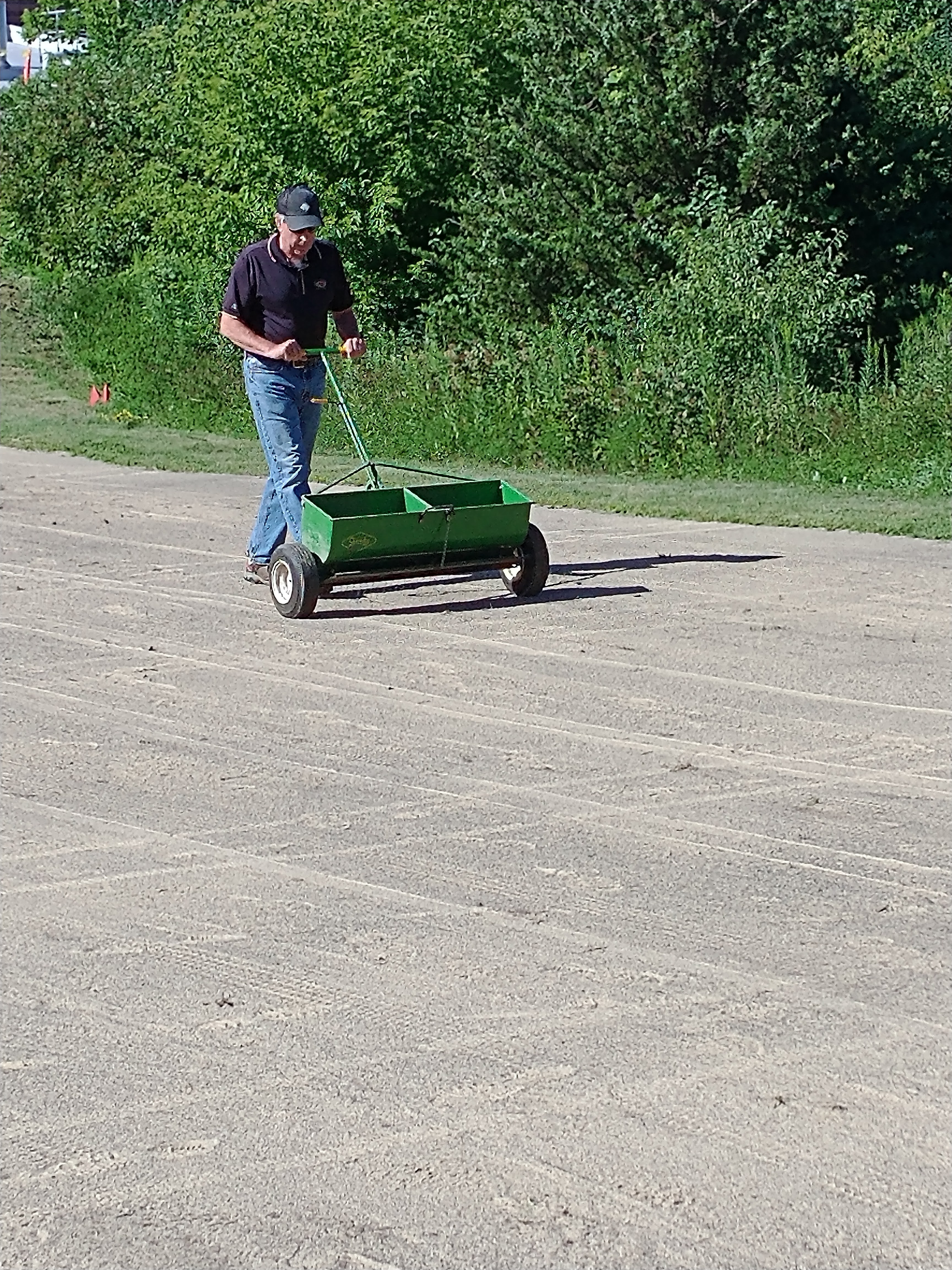
We then I seeded using a drop spreader three directions. 
Note the blackened sand. This is from 1.5 lbs of nitrogen per thousand square feet from Milorganite. 
I like to load of sand with a liberal amount of slow release organic nitrogen when I seed directly into it. 
I have found that this is a good way to grow in bent-grass from seed.


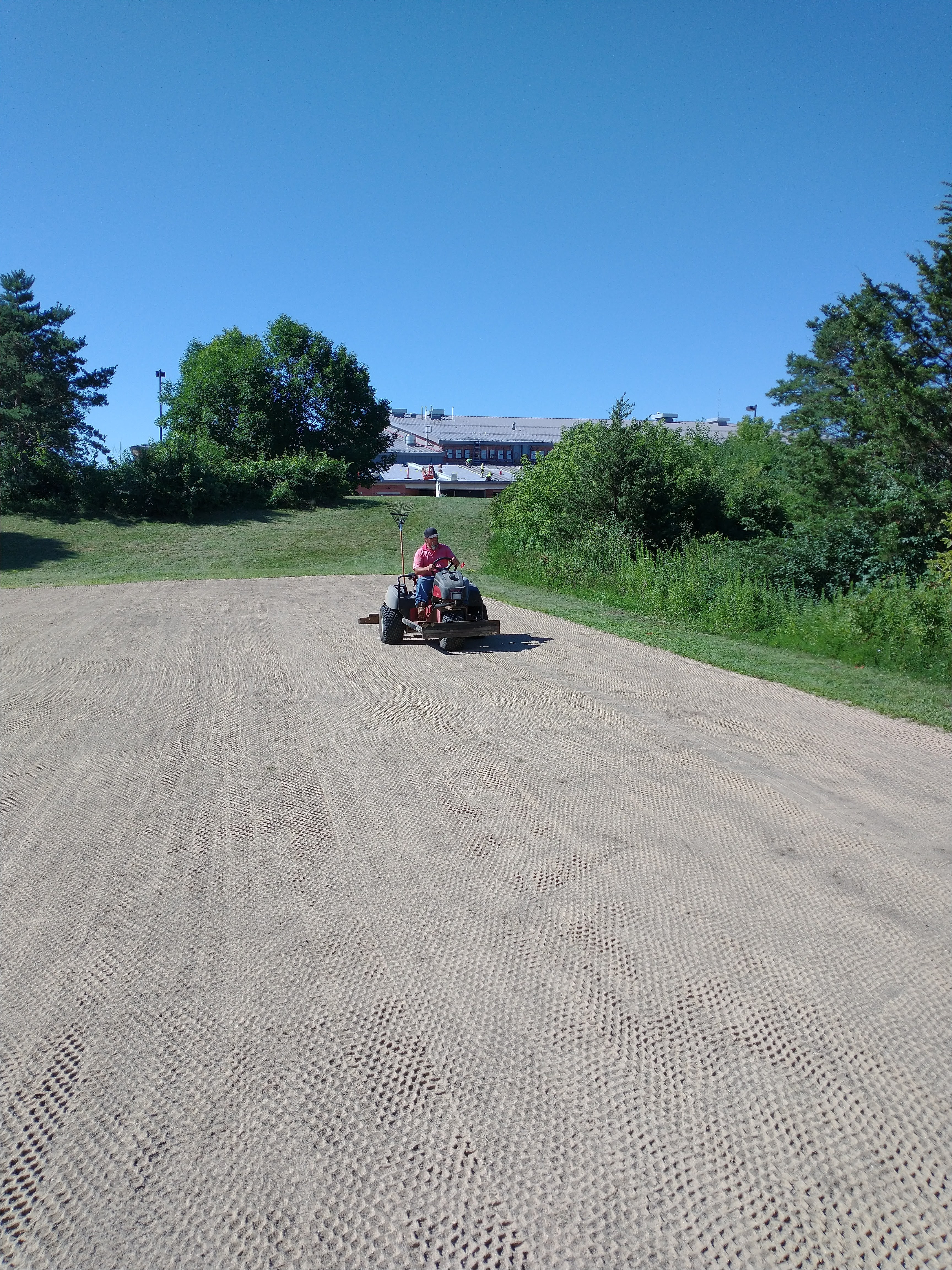
The seed was then dimpled in with a Toro Sand Pro. This assures good soil to seed contact. 


We then fired  up the sprinklers and irrigated three times a day to maintain moisture for germination


Here you can see the first mowing. The Poa annua plugs are in the foreground 
and forming a nice sod along with the seeded area in the back ground.


Aerification 2023


Here you can see that we have applied the sand prior to aerification with .60 inch solid tines.


The brushing of the sand in the morning does not provide a perfect looking playing surface, 
but the ball roll is remarkably good. 


Aerification Verification


The method that we are using to measure and quantify consistency of ball roll on our greens was conceived and designed by one of our Bittersweet members Ken Krozel.
 
Here we see Ken watching the ball roll toward the target plate. 

The photo doesn't show this clearly, but the plate is etched with a zero in the center, and with plus inches to the right of zero and minus inches to the left of zero. 


Here you can see that the ball is rolled from a fixed point on Ken's ramp toward the plate. 

The ball is rolled 20 times and Ken records the strike point at which each ball roll touches the plate. 

This gives Ken a quantifiable reading on ball roll consistency. 


 Ken also films the roll of each ball in slow motion to evaluate smoothness of roll.

This evaluation was performed prior to aerification and four days after we aerified greens to evaluate how our method of greens aerification effects ball roll consistency. 

Our process of greens aerification is to aerify on the first week of August accordingly:
  1. One week prior to the aerification the greens are sprayed with Daconil Ultrex 4.25 oz. + Thiram 4.25 oz. + Aneuw 4 oz./acre + .10 lbs N from Urea. 
  2. Waupaca Fines Free sand topdressing is first applied at 15 tons per acre in front of the aerifier.
  3. A walking behind aerifier is then operated over the top of the sand using .60 inch solid tines on a 2 x 2 inch pattern at two inches depth. 
  4. A sweep and fill brush is then used to brush the sand into the holes in three directions.
  5. A Smithco roller was then used to roll the green one time. 
  6. In the afternoon hours a cocoa mat drag brush is then used to brush the green two more directions.
  7. A half inch of irrigation water is applied to the greens overnight with a Pervade wetting agent Tablet placed in the wet well of the pump house.

The results of the evaluation demonstrate that our method produced greens which were 93% as consistent as the greens prior to aerification.

We feel that the success of our results were owed to the timing of the aerification during the first week of August when greens typically heal fastest owing to the peak soil temperatures of this period.  

Saturday, March 22, 2014

3-22-14

The sun is getting higher in the sky and the days are growing longer. The winter of 2014 is slowly giving way to spring.


In the shaded areas there is still a foot or so of snow.


It is amazing how much shade is cast by trees even when they are leafless.


The Poa annua patches on the golf course are very visible this time of year. Most of our Poa patches are on the edges of the greens where the mowers pivot. These areas will receive extra aerification and bentgrass seed. 


The third green is situated in a wind lane with southern exposure. This green has been clear of snow for almost three weeks now - the wind and exposure really took the color out of it but it will start greening up with warmer temperatures.


Saturday, June 22, 2013

New Mowing Program

This year we have developed walking lanes from tee to fairway. The early morning players are able to follow these lanes and keep their feet dry from early morning dew.


The walking lanes are aimed towards the best angle of ball flight from the tee. They are not always in the exact center of the hole corridor but more or less along the best lines for aiming the tee shots. 


The fairway cut follows the same line as the walking lane. This provides a nice visual from the tee that directs the golfer's eye to the ideal line of ball flight.


We are also mowing the rough the same direction as the fairway. Note the rough on the left side of the fairway center is mowed green to tee, same as the fairway cut. The intermediate cut however is mowed in the opposite direction. This provides a really nice contrast and outline of the hole. I feel that the ground contours are more visible with these cuts than they are with the checkerboard fairway and striped rough patterns.


In areas where the intermediate cut is widened to help the high handicap players run the ball in, the reverse direction of cut is pushed to the perimeter. This gives the golf hole the illusion of being wider than it actually is. 


The intermediate cut is widened around areas where the high handicap golfer may miss. With this mowing pattern a golfer may miss long. The intermediate cut can be used in this way to maintain a healthy 2.5 inch rough, while providing an easier playing surface in the areas where the high handicap players struggle. 


On this hole we pushed the intermediate out on the left side of the green so the golfer can miss left. From 1.25" the shot is much easier than 2.5 inches. Just trying to make the game more fun for everyone!


We are gradually bringing the intermediate down to 1" and greening it up a bit to provide tighter lies.


Bunker edging is nearly complete. On some bunkers we have cut back over a foot of turf to get back to the original edges.